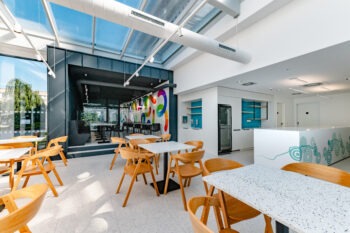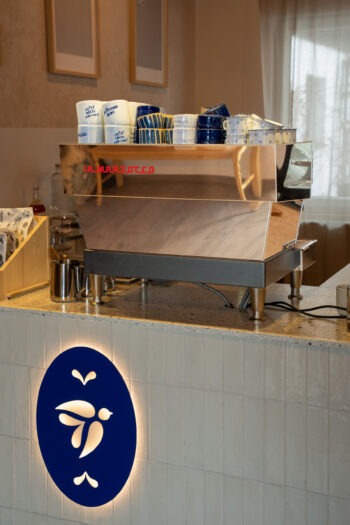


When artist, graphic designer, and illustrator Vojtěch Čižmář designs his own kitchen, it’s clear that the result won’t be an ordinary project. And when his wife, who shares his love for playful design, bold colors, and sustainability, joins in, something truly unique comes to life—a kitchen that is as functional as it is an artistic installation. We’re thrilled that we could be part of it with our recycled panels.

The interview is answered directly by Vojtěch Čižmář.
How did you first hear about Plastic guys, and what caught your attention about our panels?
We discovered Plastic guys in 2020 at the Olympic Festival in Brno, at Riviéra. We were immediately fascinated by a melted panel made of LEGO, and we knew back then that we would want to use these panels in the future.
What led you to use our panels specifically for your kitchen?
The main reason was that, from the start, we wanted an interesting custom countertop rather than a fully bespoke kitchen—so the cabinets themselves are just “basic IKEA.” We also love the terrazzo-like structure, which Plastic guys technology makes possible. We designed an exact mix of colors, chip sizes, and proportions, which was then melted into the final panel. After a few sample tests, we were happy with the result.
Which material properties were the most important to you in the kitchen?
We wanted it to be clear that the kitchen is alive—that it’s a space for cooking, working, and passionate conversation. If wine or coffee spills, it should wipe off easily. And when a scratch appears, it shouldn’t feel like a flaw, but rather like a mark in the kitchen’s life story—a patina that adds beauty.
How was it to work with the panels during installation?
You can’t cut these panels with a regular jigsaw because the blade overheats and melts the plastic as you cut. It’s also an extremely hard material—impossible to manage at home. So after the carpenter measured everything, we took the panels to Jirka’s workshop, where he kindly cut and shaped them for us.
Is there a particular detail or moment in the kitchen you’re especially proud of?
The rounded corners of the panels are beautiful, but the real showpiece is the inversely rounded corner. The material also allows for an undermount sink, so you can sweep crumbs straight into it. There’s even one tiny “mistake”: a single red speck on the panel right next to our red electric kettle—a perfect coincidence. The blue color of the handles and speckles carries throughout the apartment, complemented by yellow and red, because we love primary colors in the Bauhaus style.

How do guests react when they find out the kitchen is made from recycled plastic?
Our family and friends are used to bold solutions, vibrant colors, and playful design—we love collecting and creating it because that’s our life. I’m an artist, illustrator, graphic designer, and art teacher. Together with my wife, no idea ever feels “too colorful” or “too crazy,” and we love to push the boundaries of convention—at least in home design. But the kitchen always grabs attention first, and visitors can’t resist touching the countertop.
Did you consider other materials? Why did you ultimately choose our panels?
We also considered engineered stone, but it was three times more expensive and didn’t have the same pleasant surface finish as the PG panels. Plus, we weren’t thrilled with the “chemical composition” of artificial stone.
The main challenge was installing and aligning the panels with each other. The material is rigid and unyielding, which made installation tricky.
Was there any concern or challenge you had to overcome during the project?
Here’s a bit more detail: As members of Gen Z, we know sustainability has to come first in every part of our lives. We intentionally don’t buy furniture or household items from cheap chains (Pepco, Jysk, Action, Kik…). On the other hand, we really support IKEA, because it teaches people about the circular economy.
We even returned several pieces from our old apartment to IKEA’s second-life program. The leftover parts and screws from this kitchen assembly also went back to IKEA. We see IKEA as a corporation that resists blind profit-making and unsustainable growth. That’s one of the reasons we chose the METOD kitchen.
Beyond that, we invested in timeless furniture from brands that will last for decades (TON, Vitra, Pedrali…). We believe timeless design, which you don’t have to throw away when trends fade, is the foundation of a sustainable and stylish home.

What’s your general view on sustainability in interior design?
Absolutely essential. We can’t imagine using any new material in the future that isn’t sourced from recycling. It feels wrong to extract fossil or mineral resources when we already produce so much waste that can be repurposed.
Plastic guys manages to give ecology a luxurious feel—showing that recycling and green solutions don’t have to mean a low budget or a “hippie” label.
Do you plan to work with our material again in the future?
Marble had its time, and we’re glad that era is over. Right now, we’re waiting for a coffee table to be cut from the leftover panels.
Bold design begins with the material.
When the space of everyday life connects with a colorful vision and conscious material choice, the result is a kitchen that is both practical and visually captivating. Every detail, every rounded corner, has a purpose and a place.
Thank you for letting us be part of this small manifesto of daily aesthetics. And if you’re thinking about how to bring recycling into your own space, get in touch with us.