

Plastic is one of the most widely used materials in the world. We encounter it every day – in food packaging, electronics, or household appliances. However, most of these products have a short lifespan and end up as waste. At Plastic guys, we believe that plastic deserves a second chance. That’s why we have developed a process that transforms waste into unique and durable design products.

Take a look at the journey of plastic – from discarded product to finished piece of furniture.
1. The Original Product
It all begins with materials we all know well — yogurt cups, broken keyboards, discarded refrigerators, and other plastic products. But behind these familiar objects lies another source: industrial plastic waste. This includes rejected parts, trimmings, and unsellable components from the production of appliances, packaging, or electronics. While manufacturers see it as waste, we see it as a valuable resource.
Through the systematic collection and sorting of this production waste, we ensure it doesn’t end up in landfills or incinerators. At this very first stage, we turn a problem into an opportunity — conserving primary resources and reducing the amount of waste that would otherwise burden the environment.

2. Plastic Shreds / Granulate
The next step is mechanical processing. The collected items are sorted by type of plastic and then shredded into small pieces – creating plastic shreds or granulate.
In this form, the material becomes reusable. It is lightweight, easy to store, and ready for the next stage. This step is a true example of the circular economy in practice: what was recently waste now gains the potential to become a building block for a design product.


3. Intermediate Product: the “Mínus” Design Panel
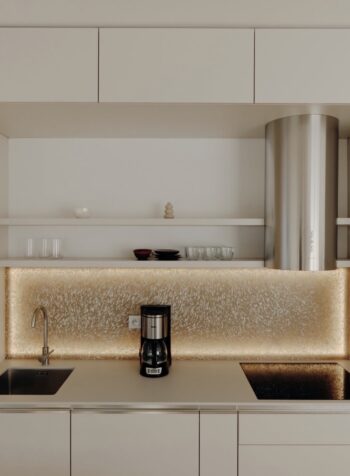
From the granulate, we press solid panels that stand out not only for their durability but also for their appearance. The texture and color emerge naturally depending on the plastics used – we don’t add any artificial colors or patterns. The result is that each panel is a one-of-a-kind original.
These panels have wide applications: they can serve as cladding, work surfaces, partitions, or shelving boards. Architects and designers value the fact that the material is both ecological and easy to work with – it can be cut, drilled, or shaped just like traditional materials.


4. The Final Product
In the final stage, our panels are transformed into finished products and elements that find their place in both interior and exterior spaces. Within the Off-space brand, they become tables, chairs, and lighting pieces — but can also become also wall claddings, work surfaces, partitions, or outdoor installations.
Each piece represents a fusion of design, functionality, and environmental responsibility. It’s not just an aesthetic addition to a space, but proof that a material once considered waste can gain a new and valuable life.


And What’s Next?
Our work doesn’t end when the final product is made. A major advantage of recycled plastic panels is that they can be recycled again and again – up to 10 times.
This closes the entire cycle and proves the principle of the circular economy: no plastic has to be waste forever. Every product can become a resource for something new.
The journey of plastic is a journey from waste to design – and back again. By choosing to use recycled materials, you help reduce the carbon footprint, support sustainable development, and contribute to making design not only aesthetically valuable but also ecologically meaningful.